The truth is unevenly distributed
Let's kick this off.
Noisy is a bet.
On a ski trip a few weeks ago, with my son pretending to be asleep on the pullout, an old friend from high school and I massaged cannabis cream into our tired thighs (I'm a snowboarder; my thighs felt worse), nursed our zero-alc Quebecois microbrews, and surveyed the state of modern life.
You know, like old buds do.
At one point, one or the other of us expressed our annoyance, our disdain, our frustration with the so much noise out there in the media designed to attract eyeballs or "drive engagement", and how there must be some other signal worth paying attention to, that behind all that inchoate mix of drama and spectacle, the pile-up of one more inexorable news event after news event, there might be truer, subtler, quieter signals we can uncover; signals to all the parts of the system that were moving.
Well, our bet is that these signals are to be found in documents. That's where these slow structural shifts actually happen, in the firehose of filings, records, and reports that set the conditions out of which the news emerges.
Like this one, for example.
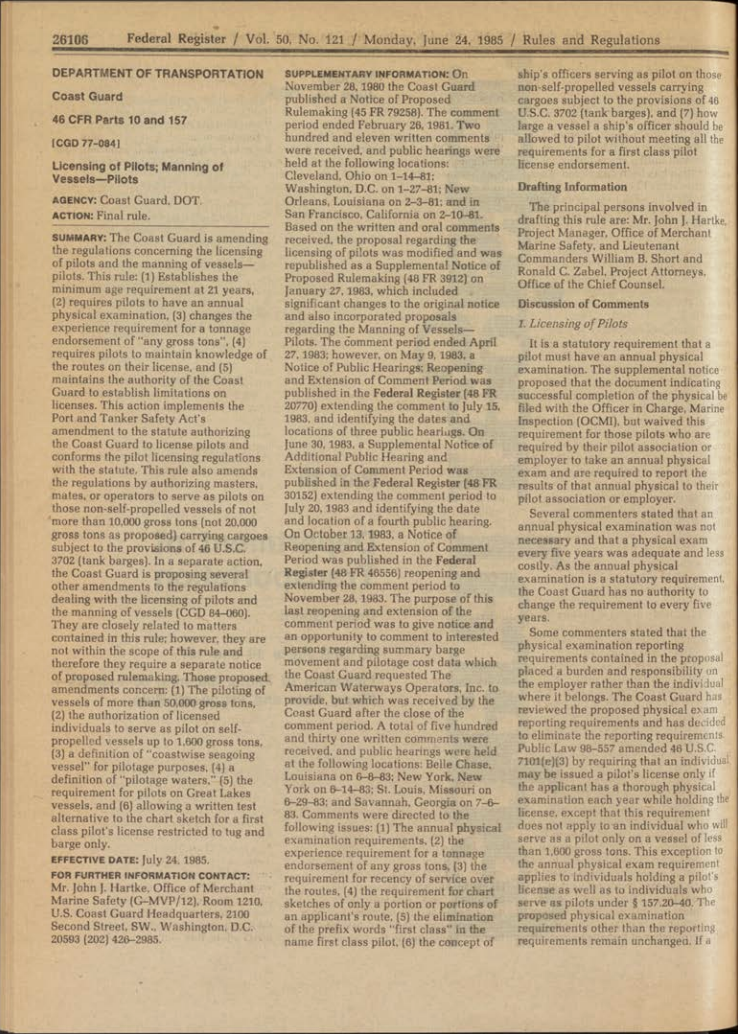
This is a page from the Federal Register dated June 24, 1985 — a routine-looking rule change from the Department of Transportation granting pilotage exemptions on certain Alaskan waters. Four years later, the Exxon Valdez ran aground in Prince William Sound. Everyone heard about the drunk captain. Fewer people read the filing.
And even when it is distributed, it tends to land in a 400-page regulatory filing with a title like "Regulatory Capital Rules: Regulatory Capital and Standardized Approach for Risk-Weighted Assets." Whoever wrote that title put on their "I'm writing a policy paper" hat, and, just like we all do when asked to wear that kind of hat, we start writing the same way.
Obscurantist.
But let's resist the easy critique. The obscurity is just an artifact, the natural output of documents written not to communicate but to to satisfy the internal logic of systems that have their own grammar, requirements, self-referential architecture, and which, like all systems that survive long enough to develop institutional gravity, quietly, incrementally, requiring no conspiracy, no deliberation, no one rubbing their hands together in a back room choosing opacity as a strategy, tend to accumulate more definition, more capacity, more power toward whoever is already holding the levers.
We don't see it happening, the slow ratcheting, until...
Until whatever was quietly decided in a document nobody read produces an outcome dramatic enough to demand a headline and a hearing, at which point the whole sequence looks, in hindsight, not just predictable but inevitable, the documents that made it so having been publicly available, in plain sight, the entire time.
Our bet is that these documents act as tea leaves.
That power, with its legion of lawyers and lobbyists and regulatory specialists who do nothing but read and write in this language all day, shows up most honestly not in its press releases or its public statements but in the act of small screw-tightening changes, individually deliberate in the narrow sense (someone decided to change that definition, someone petitioned for that exemption, someone drafted that carve-out) but so widely distributed across agencies and jurisdictions and filing types and regulatory calendars, so thoroughly disaggregated from any single readable narrative, that no one, likely not even the people who benefit most from the accumulation, fully grasps the shape of what is being built, until the dramatic event finally makes it legible, and everyone, without exception, acts surprised.
Noisy is an attempt at making this legible, earlier.
It's an experiment, honestly. We don't know yet what it becomes. Stay tuned.